A Leopard and a Cheetah
On a safari in Africa, could you distinguish between cheetahs and leopards? We’ll explain how to distinguish between Cheetahs and Leopards, which can be challenging if you’re new to safaris. Fortunately, there are a few distinguishing characteristics that can be used to identify these well-known African large cats. Both cheetahs and leopards can be seen on safari in various parts of Africa, however sightings can change according on the location. While leopards are more frequently seen in wooded areas and along river systems, cheetahs prefer open savannas. You may recognize your cat by using the following clear distinctions between cheetahs and leopards:
- Body size
- Eyes
- Leopard spots and Cheetah’s spot
- Speed
- Habitat
- Who wins in a fight?
- Prints
Body size and Built
The first significant distinction between leopards and cheetahs is how they are built. Leopards are short and stocky, while cheetahs are tall and slim.
Leopards are bigger and heavier. They are large, strong cats with shorter legs and larger heads that can climb trees. Compared to leopards, cheetahs are lighter and more slender African cats. Their physique allows them to run fast after prey. Compared to leopards, they have longer legs and smaller heads.
Eyes
Looking at their eyes is the simplest way to distinguish between a cheetah and a leopard. Black lines run along the faces of cheetahs. These “tear lines” extend straight down to the cheetah’s mouth from its inner eyes. These lines are absent in leopards. The most obvious distinction between a cheetah and a leopard is this.
Leapards tend to have more green eyes, whilst cheetahs often have more amber eyes. Because they hunt at night, leopards also have significantly larger eyes and pupils than cheetahs, which typically hunt during the day and have smaller eyes and pupils.
You can truly appreciate these African large cats’ feline traits by getting up close and personal. The ideal chance to hone your cheetah vs. leopard identification skills in the jungle is a big cat safari in Kenya.
Big cat lovers can enjoy an affordable Kenya Safari in Masai Mara for as little as $1,127 per person sharing. This beautiful 4-day Masai Mara Safari is ideal for those on a tight budget and schedule because leopards and cheetahs are frequently spotted.
Spots
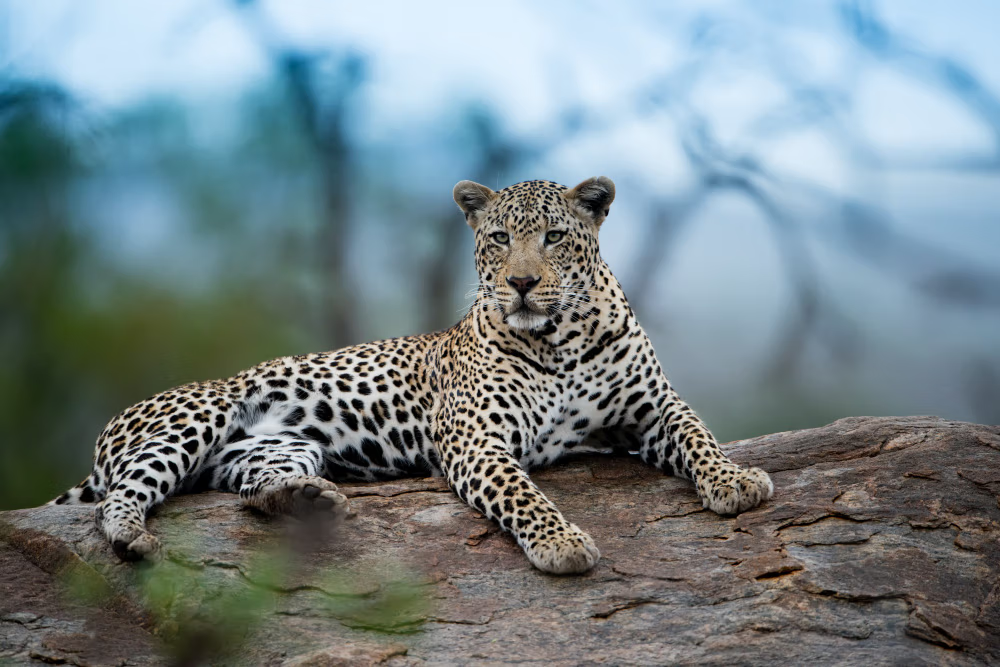
The markings are another significant distinction between cheetahs and leopards. Cheetah spots have an oval or solid round form. Leopard spots are asymmetrical patterns that are arranged in circles to resemble roses. These are deep brown in the center with a black edge that is blotched.
Cheetah markings are frequently solid, with smaller dots strewn among larger ones. Because of the various-sized smeared marks, their coats might occasionally appear mottled. Compared to rare cheetah spots, leopard spots are frequently more noticeable on their faces, particularly on their muzzles.
In the African jungle, both African big cats have excellent concealment. Visit a private game reserve in South Africa’s Greater Kruger Park for the highest chance of spotting one of these predators. Travelers can take a small group private tour at a reasonable cost on an African budget safari. Our exclusive tented safari in Sabi Sands includes 4×4 game drives led by a knowledgeable guide who is familiar with the preferred hiding places of leopards and cheetahs.
Habits and Environment
Leopards are nocturnal animals. They prefer to sleep during the day and hunt at night. Although they have also been observed to hunt by moonlight, cheetahs follow the opposite pattern. It’s very unique to see a huge cat because both cheetahs and leopards are adept at hiding. knowledgeable game tracker will constantly urge you to watch the trees. During the day, leopards can be found here. Large open areas like grasslands and savannas are preferred by cheetahs. Cheetahs may chase prey at peak speeds in these environments. Explore a range of African habitats with knowledgeable trackers.
Speed
The manner African large cats move is one of the biggest distinctions between them. To begin, let’s compare the speed of leopards and cheetahs.
Cheetahs can accelerate from 0 to 64 miles per hour in three seconds, reaching a top speed of 110–120 km/h, or 75 miles per hour.
Cheetahs are designed to move quickly. Their long tails are flatter than leopards’ to help them stay balanced at fast speeds, and their hind feet are bigger than their front feet to aid in acceleration. In order to breathe quickly, cheetahs also have a bigger nasal cavity. It’s interesting to note that they can’t maintain their maximum speed for very long because doing so could overheat their brains. Leopards had a top speed of 50–60 km/h (31–37 mi/h). It simply wouldn’t be a fair race, as you can see. The speed of cheetahs is roughly double that of leopards!
However, when we discuss climbing, the cheetah loses its superiority. Leopards can ascend with a newly slaughtered prey because their front feet are larger than their hind feet. Additionally, their tails are more rounded to aid in their climbing balance. Cheetahs are not competitive in terms of strength and agility.
Who would win in a fight?
The cheetah would be better off choosing to flee rather than fight. Despite their diminutive size, leopards possess more strength. Compared to the short, skinny cheetah, the leopard is stronger due to its muscular frame. Additionally, a leopard’s strong jaws, teeth, and keen claws contribute to its supremacy.
We are occasionally asked if cheetahs are eaten by leopards. Usually, the answer is no. Leopards may occasionally hunt cheetah cubs, although they rarely prey on cheetahs. When leopards attempt an assault, cheetahs can usually outpace them. In a similar vein, you might wonder if cheetahs consume leopards. No, not in most cases. Although they rarely hunt leopards, cheetahs have occasionally been reported to kill leopard pups.
Cheetah Print vs Leopard Prints
Check for spots: rosette marks for leopards and solid round for cheetah spots.
Because of its striking and classic appeal, leopard print is a popular option among fashion designers. How does a leopard pattern appear? A cheetah print has a cooler, lighter tone, whereas it has a warm, golden tan color. You can’t go wrong with a cheetah print for a more sophisticated and modern appearance.
Even though most individuals have animal patterns in their closets, it is definitely advisable to avoid wearing them when going on an African safari. In fact, a safari park attempted to outlaw animal print because the rangers thought it frightened and perplexed the animals.
Feet and Claws
Cheetahs can accelerate and move quickly because of their large back feet. Leopards can climb trees and hoist their food away from scavengers because to their larger front feet. The claws of a cheetah and a leopard are another important distinction. Because their claws are not retractable, cheetahs can pivot quickly and accelerate quickly. Retractable claws are essential for leopards to climb trees and leap on prey.
Tail
The tail is another minor distinction between a cheetah and a leopard. Another distinctive anatomical feature of cheetahs is their flatter tails. A cheetah can steer and maintain balance while running at fast speeds thanks to its flattened tail, which serves as a rudder. The rounder form of leopards’ tails helps them stay balanced when scaling trees.
Hunting
Leopards and cheetahs hunt in entirely different ways. Cheetahs use their speed to pursue and capture their prey, tripping them with their claws and pursuing their throats. Leopards prefer to ambush their victims by tracking them for extended periods of time while crouching low to the ground before leaping on them. Leopards and cheetahs may hunt in various locations and at different times. Because they have weak night vision, cheetahs typically hunt during the day, while leopards hunt at night. Compared to leopards, who employ their camouflage and typically hunt in more densely covered areas where it is easier to conceal, cheetahs prefer to hunt in open expanses, which gives them more freedom to reach top speeds.
Life Span
In the wild, cheetahs typically live 8–10 years, but leopards can live up to 12–17 years. While leopards mate year-round, cheetahs often do so during the dry season. The gestation period of a female cheetah is approximately 90-95 days, whereas that of a female leopard is approximately 90-105 days. The survival rate of cheetah cubs is lower than that of leopard cubs. Because the mother may abandon her kids for a long time while seeking for food, cheetah cubs are particularly vulnerable to wildlife predictors. While leopards often give birth to litters of two to three pups at a time, cheetahs typically give birth to litters of four to six cubs.
Sound
While leopards occasionally growl, snarl, hiss, and roar, cheetahs purr. The only large cats who are unable to roar are cheetahs.
Network
Leopards, which belong to the Big 5, are vicious predators and typically lead solitary lives. It’s most likely a mother and pup or mating partners if you encounter multiple leopards at once. Cheetahs frequently roam alone or with their siblings.