On a safari in Africa, could you distinguish between cheetahs and leopard? We’ll explain how to distinguish between Cheetah and Leopard, which can be challenging if you’re new to safaris. Fortunately, there are a few distinguishing characteristics that can be used to identify these well-known African large cats. Both cheetah and leopard can be seen on safari in various parts of Africa, however sightings can change according on the location. While leopards are more frequently seen in wooded areas and along river systems, cheetahs prefer open savannas. You may recognize your cat by using the following cheetah and leopard difference:
- Body size
- Eyes
- Leopard spots and Cheetah’s spot
- Speed
- Habitat
- Who wins in a fight?
- Prints
Body size and Built
The first cheetah and leopard difference is how they are built. Leopards are short and stocky, while cheetahs are tall and slim.
Leopards are bigger and heavier. They are large, strong cats with shorter legs and larger heads that can climb trees. Compared to leopards, cheetahs are lighter and more slender African cats. Their physique allows them to run fast after prey. Compared to leopards, they have longer legs and smaller heads. A leopard might need to overpower a prey and drag it to a tree. This is a very straneous exercise that needs tremendous strenth and musculinity.
Eyes
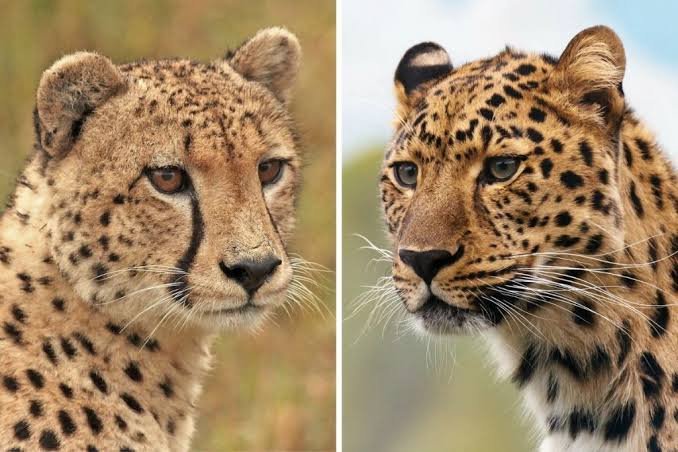
Looking at their eyes is the simplest way to spot cheetah and leopard difference. Black lines run along the faces of cheetah. These “tear lines” extend straight down to the cheetah’s mouth from its inner eyes. These lines are absent in leopards. The most obvious distinction between a cheetah and a leopard is this.
Leopard tend to have more green eyes, whilst cheetah often have more amber eyes. Because they hunt at night, leopards also have significantly larger eyes and pupils than cheetah, which typically hunt during the day and have smaller eyes and pupils.
You can truly appreciate these African large cats’ feline traits by getting up close and personal. The ideal chance to hone your cheetah vs. leopard identification skills in the jungle is a big cat safari in Kenya.
Big cat lovers can enjoy an affordable Kenya Safari in Masai Mara for as little as $1,127 per person sharing. This beautiful 4-day Masai Mara Safari is ideal for those on a tight budget and schedule because leopard and cheetah are frequently spotted.
Spots
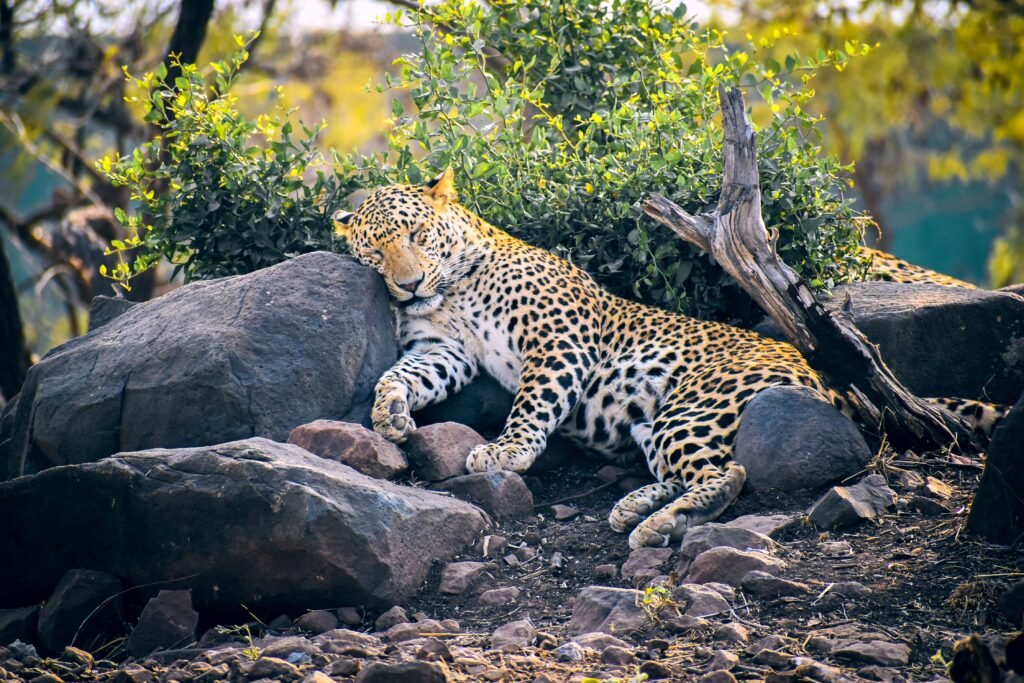
The markings are another way you can notice difference between cheetah and leopard. Cheetah spots have an oval or solid round form. Leopard spots are asymmetrical patterns that are arranged in circles to resemble roses. These are deep brown in the center with a black edge that is blotched.
Cheetah markings are frequently solid, with smaller dots strewn among larger ones. Because of the various-sized smeared marks, their coats might occasionally appear mottled. Compared to rare cheetah spots, leopard spots are frequently more noticeable on their faces, particularly on their muzzles.
In the African jungle, both African big cats have excellent concealment. Visit a private game reserve in South Africa’s Greater Kruger Park for the highest chance of spotting one of these predators. Travelers can take a small group private tour at a reasonable cost on an African budget safari. Our exclusive tented safari in Sabi Sands includes 4×4 game drives led by a knowledgeable guide who is familiar with the preferred hiding places of leopard and cheetah.
Habits and Environment
Leopards are nocturnal animals. They prefer to sleep during the day and hunt at night. Although they have also been observed to hunt by moonlight, cheetahs follow the opposite pattern. It’s very unique to see a huge cat because both cheetahs and leopards are adept at hiding. knowledgeable game tracker will constantly urge you to watch the trees.
During the day, leopards can be found here. Large open areas like grasslands and savannas are preferred by cheetahs. Cheetahs may chase prey at peak speeds in these environments. Explore a range of African habitats with knowledgeable trackers.
Speed
The manner African large cats move is one of the biggest distinctions between them. To begin, let’s compare the speed of between cheetah and leopard
Cheetah can accelerate from 0 to 64 miles per hour in three seconds, reaching a top speed of 110–120 km/h, or 75 miles per hour.
Cheetah are designed to move quickly. Their long tails are flatter than leopards’ to help them stay balanced at fast speeds, and their hind feet are bigger than their front feet to aid in acceleration. In order to breathe quickly, cheetahs also have a bigger nasal cavity. It’s interesting to note that they can’t maintain their maximum speed for very long because doing so could overheat their brains. Leopards had a top speed of 50–60 km/h (31–37 mi/h). It simply wouldn’t be a fair race, as you can see. The speed of cheetahs is roughly double that of leopards!
However, when we discuss climbing, the cheetah loses its superiority. Leopards can ascend with a newly slaughtered prey because their front feet are larger than their hind feet. Additionally, their tails are more rounded to aid in their climbing balance. Cheetahs are not competitive in terms of strength and agility.
Who would win in a fight between Cheetah and Leopard?
The cheetah would be better off choosing to flee rather than fight. Despite their diminutive size, leopards possess more strength. Compared to the short, skinny cheetah, the leopard is stronger due to its muscular frame. Additionally, a leopard’s strong jaws, teeth, and keen claws contribute to its supremacy.
We are occasionally asked if cheetahs are eaten by leopards. Usually, the answer is no. Leopards may occasionally hunt cheetah cubs, although they rarely prey on cheetahs. When leopards attempt an assault, cheetahs can usually outpace them. In a similar vein, you might wonder if cheetahs consume leopards. No, not in most cases. Although they rarely hunt leopards, cheetahs have occasionally been reported to kill leopard pups.
Cheetah Print vs Leopard Prints
To know the difference between cheetaha and leopards you can check for spots rosette marks for leopards and solid round for cheetah spots.
Because of its striking and classic appeal, leopard print is a popular option among fashion designers. How does a leopard pattern appear? A cheetah print has a cooler, lighter tone, whereas it has a warm, golden tan color. You can’t go wrong with a cheetah print for a more sophisticated and modern appearance.
Even though most individuals have animal patterns in their closets, it is definitely advisable to avoid wearing them when going on an African safari. In fact, a safari park attempted to outlaw animal print because the rangers thought it frightened and perplexed the animals.
These two prints might look similar from a distance however, the shapes of these markings are different. It is always adviseable for tourists to wear neutral colors when on an African safari to avoid scaring off other animals within the reserve or park.
Feet and Claws
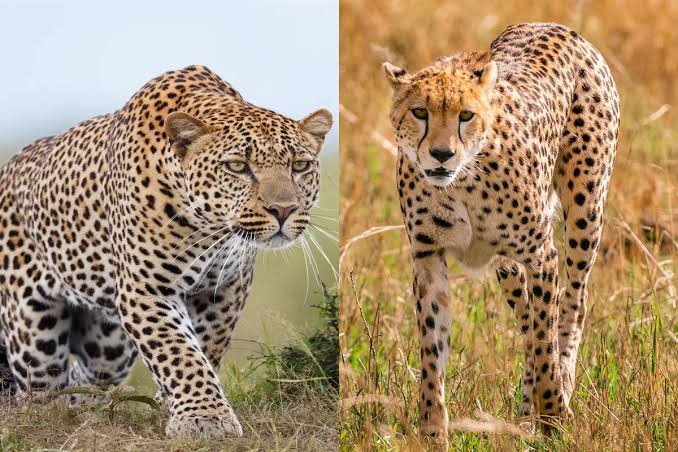
Cheetahs can accelerate and move quickly because of their large back feet. Leopard can climb trees and hoist their food away from scavengers because to their larger front feet. The claws of a cheetah and a leopard are another important distinction. Because their claws are not retractable, cheetahs can pivot quickly and accelerate quickly. Retractable claws are essential for leopards to climb trees and leap on prey.
Tail
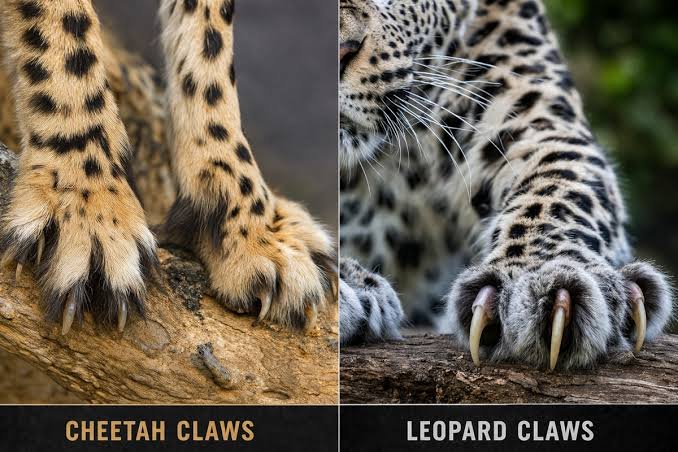
The tail is another minor difference between cheetah and leopard. Another distinctive anatomical feature of cheetahs is their flatter tails. A cheetah can steer and maintain balance while running at fast speeds thanks to its flattened tail, which serves as a rudder. The rounder form of leopards’ tails helps them stay balanced when scaling trees.
Hunting
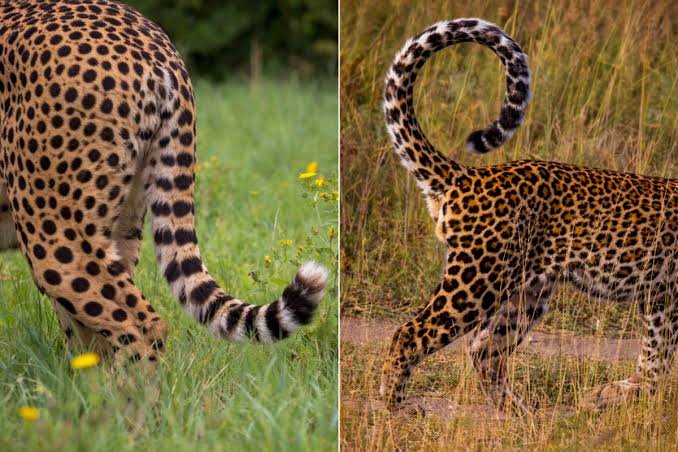
Another difference between cheetah and leopard is in how they hunt. Cheetahs use their speed to pursue and capture their prey, tripping them with their claws and pursuing their throats. Leopards prefer to ambush their victims by tracking them for extended periods of time while crouching low to the ground before leaping on them. Leopards and cheetahs may hunt in various locations and at different times. Because they have weak night vision, cheetahs typically hunt during the day, while leopards hunt at night. Compared to leopards, who employ their camouflage and typically hunt in more densely covered areas where it is easier to conceal, cheetahs prefer to hunt in open expanses, which gives them more freedom to reach top speeds.
Life Span
In the wild, cheetahs typically live 8–10 years, but leopards can live up to 12–17 years. While leopards mate year-round, cheetahs often do so during the dry season. The gestation period of a female cheetah is approximately 90-95 days, whereas that of a female leopard is approximately 90-105 days. The survival rate of cheetah cubs is lower than that of leopard cubs. Because the mother may abandon her kids for a long time while seeking for food, cheetah cubs are particularly vulnerable to wildlife predictors. While leopards often give birth to litters of two to three pups at a time, cheetahs typically give birth to litters of four to six cubs.
Sound
While leopards occasionally growl, snarl, hiss, and roar, cheetahs purr. The only large cats who are unable to roar are cheetahs. The leopard roars prodcing a harsh, dry and repetitive sound that resembles sawing wood or a series of rough coughs. Growling and snarling is often produced as an agressive warning when they are trying to defend their teritorry or food. Thye also chuff as a show of friendly, low intensity puffing sound used a means of greetings. Hissing and spitting are the sounds they produce when startled or cornered.
Cheetahs chirp which is a high pitched bird like call used by mothers and cubs to locate eeach other. Thye alos purr which is a loud continuous sound they produce through continous inhalation and exhalation. Thye can also yelp which is a n explosive high pitched cry that is carried over a long distance. Whn they are in danger they can hiss or growl which is a defensive sound whne they are threatened.
Network
Leopards, which belong to the Big 5, are vicious predators and typically lead solitary lives. It’s most likely a mother and pup or mating partners if you encounter multiple leopards at once. Cheetahs frequently roam alone or with their siblings.
How Cheetahs Hunt
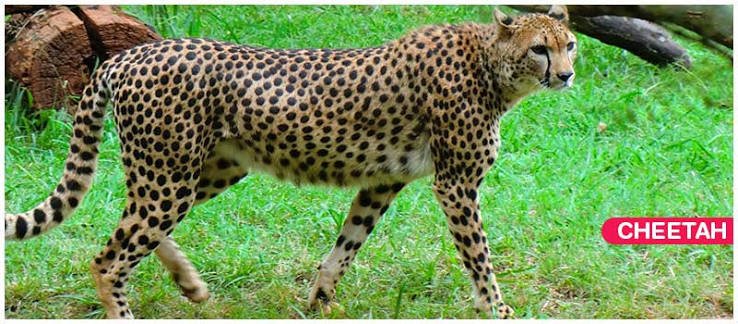
Cheetahs are primairly pursuit hunters. They oftenb hunt during daylight hours, particularly during cooler parts of the morning or afternoon. A cheetah will usually scan the surroundung landscape for suitable prey. Once it identifies a target it eill try to approach relatively close before beginning the chase.
The initial acceleration is extraordinary. The cheetah uses its long legs, flexible spine, large nasal passage and specialized body structure to maintain a high speed pursuit. However, the chase normally lasts only a short time. If the cheetah fails to catch its prey quickly, it usually abandons the pursuit to conserve energy. The typical prey cheetahs hunt include young antelopes, impalas, gazelles and other small sized animals. Thus hunting strategy clearly indicates cheetah vs leopard difference. The cheetah can easily turn a hunt into a short burst sprint. We shall take a deeper look into the way cheetahs hunt and leopards hunt in this detailed guide.
How Leopards Hunt
Leopards use a completely different hunting style. Rather than just relying on speed, they utilize stealth, camouflage, patience and strength. A leopard might hide in vegetation and wait for an opportunity to approach its prey. Once close enough it launches into a powerful ambush.
As opposed to cheetahs leopards are capable climbers. Most of the time after killing their prey they drag or carry it into a tree where it is less accessible to competing predators such as lions and hyenas. This behavior is one of the most recognizable aspect of leopard ecology. The leopard’s muscular body and powerful limbs make this possible. Therefore when examining the difference between cheetah and leopard the hunting behavior makes one of the clearest distinctions. A cheetah always wants to out run its prey while a leopard wants to surprise it.
Cheetah vs Leopard: What Do they Eat?
Both are predators however, their feeding habits differ in accordance to the availability of prey. Cheetahs often target the relatively small and medium-sized prey. Gazelles are among their well known prey species but they may also hunt young antelopes, hares birds and other animals.
Because cheetahs are relatively lightweight compared to other large African predators, they usually avoid unnecessary confrontations wit large predators.
Leopards have a much broader dietary range. They can hunt antelopes, monkeys, warthogs, rodents, birds, reptiles and other animals. Their adaptability allows them to survive in different environments. This flexibility is among other important factor in cheetah vs leopard comparisons.
Cheetah vs Leopard Habitat
Habitat is another major difference. Cheetahs are strongly associated wit open landscapes such as savannahs, grasslands and semi arid regions. These environments allow them to use their speed effectively.
A cheetah chasing prey through dense forest would not have the same advantage it has on an open plain. Leopards are much more adaptable. They can inhabit savannahs, woodlands, forests, mountains, scrublands and areas close to human settlements. They are capable of using vegetation as cover and can adapt to different environmental conditions. This adaptability makes leopards one of the most widely distributed large cats.
Thus the difference between cheetah and leopard extend beyond their appearance. Their preferred environments are closely connected to their hunting strategies.
Cheetah vs Leopard Climbing Ability
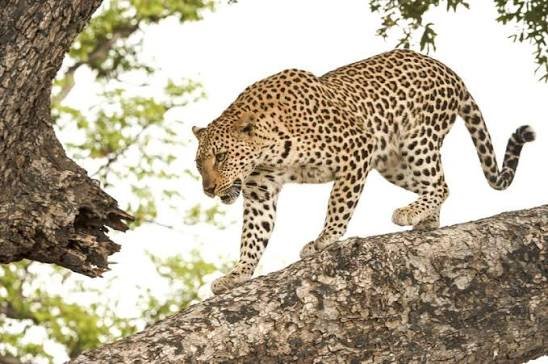
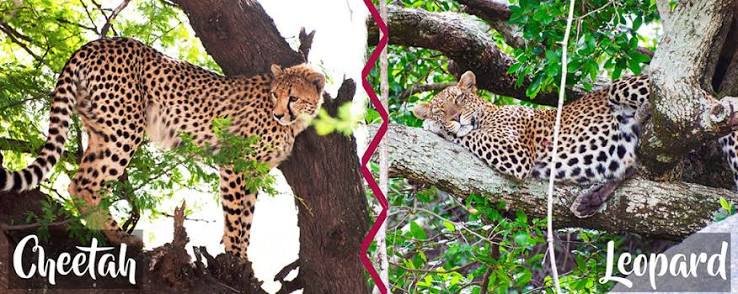
If you see a spotted big cat relaxing in a tree during an African Safari, there is a good chance you are looking at a leopard. Leopards are excellent climbers. They frequently climb trees to rest, escape danger, survey their surroundings or protect kills from scavengers and competing predators.
Cheetahs can climb particularly when young but they are not specialized tree climbers in the same way leopards are. Adult cheetahs generally spend most of their time on the ground. This provides another easy rule for understanding cheetah vs leopard. Tree dwelling spotted cat are likely to be leopard while open ground sprinting spotted cat is likely to be a cheetah. Of course wildlife identification should always consider the animal’s other physical characteristics as well.
Social Behavior Of Cheetah vs Leopard
Cheetahs and leopards also have a difference in social behavior whereby female cheetahs are generally solitary and spend most of their times raising their cubs alone. Male cheetahs on the other hand might live alone from coalitions , particularly with brothers from the same litter. These coalitions can help them defend their territories and improve their chances of successfully competing for mates.
On the other hand leopards are generally solitary animals. Adult males and females typically maintain separate territories however their ranges can differ from time to time. Mothers raise their cubs independently and teach them how to hunt and survive. The solitary lifestyles of these animals make sightings particularly exciting during a safari.
Another interesting aspect of the difference between cheetah and leopard is when they are most active. Cheetahs are active mostly during the day making them relatively easier to observe during daytime safari game drives compared to other predators. They may hunt in the morning or late in the afternoon when the temperatures are more comfortable.
Leopards are generally more active during the night and around dawn and dusk hours particularly when resting on the trees or moving through their territories. Their flexible activity pattern helps them avoid competition with other predators.
The Body Difference of Cheetah vs Leopard
Cheetahs are built more like sprinters which is their tactics of hunting. Their legs are long and lean, their spines are flexible with their chests deep enough to push oxygen through the body during a chase. Everything about their frame is built for speed and acceleration as opposed to raw strenght.
On the otherhand leopards are built like wrestles. With that said they have dense muscles, broad shoulders amd a compact frame that plays a critical role of storing power. They do not sprint down their prey, they usually stalk it and wait till the perfect time when they are close enough to poounce on it. They make sure that there is a small gap betwen them and the prey, they make sure to end the chase even before it begins.
The difference between cheetah and leopards becomes most obvious once they have successfully hunt. A cheetah will always eat fast before larger predators arrive and steal the meal. On the otherhand a leopard will drag its prey into the tree, sometimes lifitng anls that are havier than themselves several feets off the groundn and eat in complete pace without rushing.
Reproduction and Cubs
Cheetahs and leopards also differ in their reprodyuctive behavior. Female cheetahs typically give birth to several cubs after a gestation period of approximately three months. A litter might contain several cubs although survival rates can be low due to predation and other environmenatal factors.
Leopards generally give birth to smaller litters of about two to three cubs. Additionally the mother leopard hides their cubs in secured dens or areas with thick vegetation and may move thme regularly. As the cubs become older their mothers introduces them to hunting and survival skills. The mothers play an essential role in preparing the young cats for an independent life.
Cheetah vs Leopard in Kenya
Kenya is one of the best destinations in Africa for travelers interested in comparing cheetah vs leopard in the wild. The Maasai is particularly famous for its large concentration of wildlife. Cheetahs are often seen moving through the open plains where they have an added advantage on their speeds.
Leopards can also be found in the ecosystem although they are generallymore elusive. They may rest on trees, move through dense vegetation or remain hidden during the day light hours. For travellers seeking to see both animals they just need to be patient as these animals have specific territories and times they move around. With a knowledgeable safari guide you are likely to have a good time and experience finding these elusive predators.
Why Cheetah vs Leopard Identification Matters on Safari
Learning the difference between cheetah and leopard does more than help youidentify the animals. It makes the safari even more meaningful and fun for you as a tourist. When a guide points towards a spotted cat at a distance you can immediately begin analyzing its body shape, markings, movement, habitat and behavior.
Among the questions that need to be running through your head when you see them at a distance include, is it slender?, are the spots solid or rosette shaped?, doest it have black tear lines?, is it climbing a tree?, is it moving across open grassland? or is it stalking prey or preparing for a high speed chase? These observations transform wildlife sighting into a deeper understanding of animal behavior.
Frequently Asked Questions About Cheetah vs Leopard
What is the main difference between a cheetah and a leopard?
The biggest difference is how they are built and how they hunt. Cheetahs are lightweight and designed for speed while leopards are muscular and designed for stealth, strenght and ambush hunting.
Is a cheetah faster than a leopard?
Yes. Cheetahs are much faster and can reach to speeds of approximately 100-110 km/h for short sprints. Leopards generally reach to speeds of around 50-60 km/h.
How can I tell a cheetah from a leopard?
Look at the spots and face. Cheetahs have a solid black spot and a distinctive black tearlines. Leopards have rosette shaped spots and do not have prominent tear lines.
Are cheetahs stronger than leopards?
No leopards are generally stronger because they have a more mascular body, stronger jaws and powerful limbs.
Can leopards climb trees?
Yes. Leopards are exellent climbers and can climb trees to rest, escape danger or protect their kills.
Can cheetahs climb trees?
Cheetahs can climb trees to some extent, especialy wwhen young but they are not specialized climbers as leopards.
Conclusion on Cheetah vs Leopards
The cheetah vs leopard comparison reveals two remarkable predators that may look similar at first but are actually very different. The cheetah is Africa’s speed specialist thats not debateable. Its slender body, long legs, flexible spin, specialized feet and long balancing tail allow it to accelerate rapidly and chase prey across open landscpaes.
The leopard is a strenght and stealth specialist. Its mascular body, powerful jaws, retractable claws, camouflage and climbing ability make it one of Africca’s most adaptable predators. The easiest way to remeber the difference between cheetah and leopard is simple in that.
Cheetahs have solid spots, tear lines, slim bodies and incredible speed. Leopards have rosettes, mascular bodies, powerful claws and exceptional climbing ability. If you are heading out on an African safari, especiallyin kenya’s Maasai Mara, Serengeti or South Africa’s Greater Kruger, learn these differences that can make your wildlife encounter more exciting. The next time your guide points towards at a spotte cat dont just ask if it is a leopard, look carefully and know the difference before you can say what cat it is.